
Ontario is putting greater emphasis on buying local. For businesses competing for government contracts, this could create new opportunities. But is your company ready to take advantage?
Imagine you operate a small manufacturing or service business in Ontario.
You have spent years competing against larger suppliers, sometimes with deeper resources and more established government relationships.
Now, Ontario is strengthening procurement requirements that prioritize Ontario and Canadian goods and services.
Sounds like good news, right?
Potentially. But there is a catch.
Key Takeaway
Being an Ontario business does not automatically guarantee an advantage in every government procurement.
What matters is how the purchasing requirements apply to the opportunity, what you are offering, and whether your proposal demonstrates that you meet those requirements.
For suppliers, understanding this distinction could make a meaningful difference in how you approach your next government bid.
1. What is changing with Buy Ontario?
Ontario’s Buy Ontario procurement framework is designed to make public purchasing work harder for the provincial economy.
Rather than treating where goods and services come from as an afterthought, the province is placing greater emphasis on Ontario and Canadian suppliers, domestic supply chains, and local economic benefits.
The updated requirements took effect in stages during 2026.
The framework includes:
- Ontario government ministries and provincial agencies, which must apply relevant Buy Ontario requirements.
- Broader public-sector organizations, including designated hospitals, colleges, school boards and other public bodies.
- Municipalities and certain municipal entities, which have a separate directive with requirements for fleet vehicles and capital infrastructure.
An important distinction is that the rules are not identical across all public organizations.
For example, Ontario’s Building Ontario Businesses Initiative applies to covered provincial and broader-public-sector procurements. Municipalities operate under a separate directive, with different provisions.
That means a supplier bidding on a provincial service contract may face different requirements from a supplier bidding on a municipal infrastructure project.
The opportunity is real, but there is no single Buy Ontario rule that applies to every tender.
For businesses, the starting point is understanding which requirements apply to the actual opportunity.
2. Why should Ontario businesses pay attention?
Government purchasing represents an important market for businesses supplying construction materials, professional services, technology, equipment, maintenance and other goods and services.
Buy Ontario gives suppliers another reason to examine how they position themselves in this market.
Consider an Ontario business that employs local technicians, uses Ontario subcontractors and sources some materials domestically.
Previously, it might have focused its proposal almost entirely on price, technical capability and past experience.
Those factors still matter.
However, where the applicable procurement rules require or permit consideration of Ontario goods, services or business status, the company’s local capabilities may also become relevant.
There are three potential opportunities worth exploring:
- Local business positioning: Suppliers may benefit from provisions that prioritize eligible Ontario businesses in certain procurements.
- Domestic supply chains: Businesses offering Ontario-made goods or qualifying services may find their supply-chain information increasingly relevant.
- New partnerships: Suppliers may have reasons to strengthen relationships with Ontario manufacturers, distributors and service providers.
None of these advantages is automatic. They depend on the buyer, procurement category, applicable rules and solicitation documents.
The suppliers best prepared to respond will understand how their offerings align with those requirements.
3. Does having an Ontario address give you an advantage?
Here is where businesses can make a costly assumption.
An Ontario address and an Ontario-made product are not necessarily the same thing.
Consider two hypothetical suppliers competing to provide equipment for a public facility.
| Supplier A | Supplier B | |
|---|---|---|
| Business location | Ontario | Ontario |
| Equipment | Imported | Ontario-manufactured |
| Installation | Ontario technicians | Ontario technicians |
| Supply-chain evidence | Limited | Documented |
Both suppliers operate in Ontario.
However, depending on the specific procurement requirements, their bids may be assessed differently.
The relevant questions could include where the goods were manufactured, where services will be performed, or whether the business meets a defined eligibility test.
This is why businesses should distinguish between three things:
- Your business location: Where your company operates and whether it meets the applicable supplier definition.
- Your product origin: Where the goods you offer are manufactured or produced.
- Your service delivery: Where the people performing the work are located.
Do not assume that one automatically proves the others.
When a solicitation asks for domestic-content information, your response should provide the specific evidence requested.
4. Five things Ontario suppliers should do now
You do not need to wait until your next RFP lands to prepare.
Here are five practical steps worth taking.
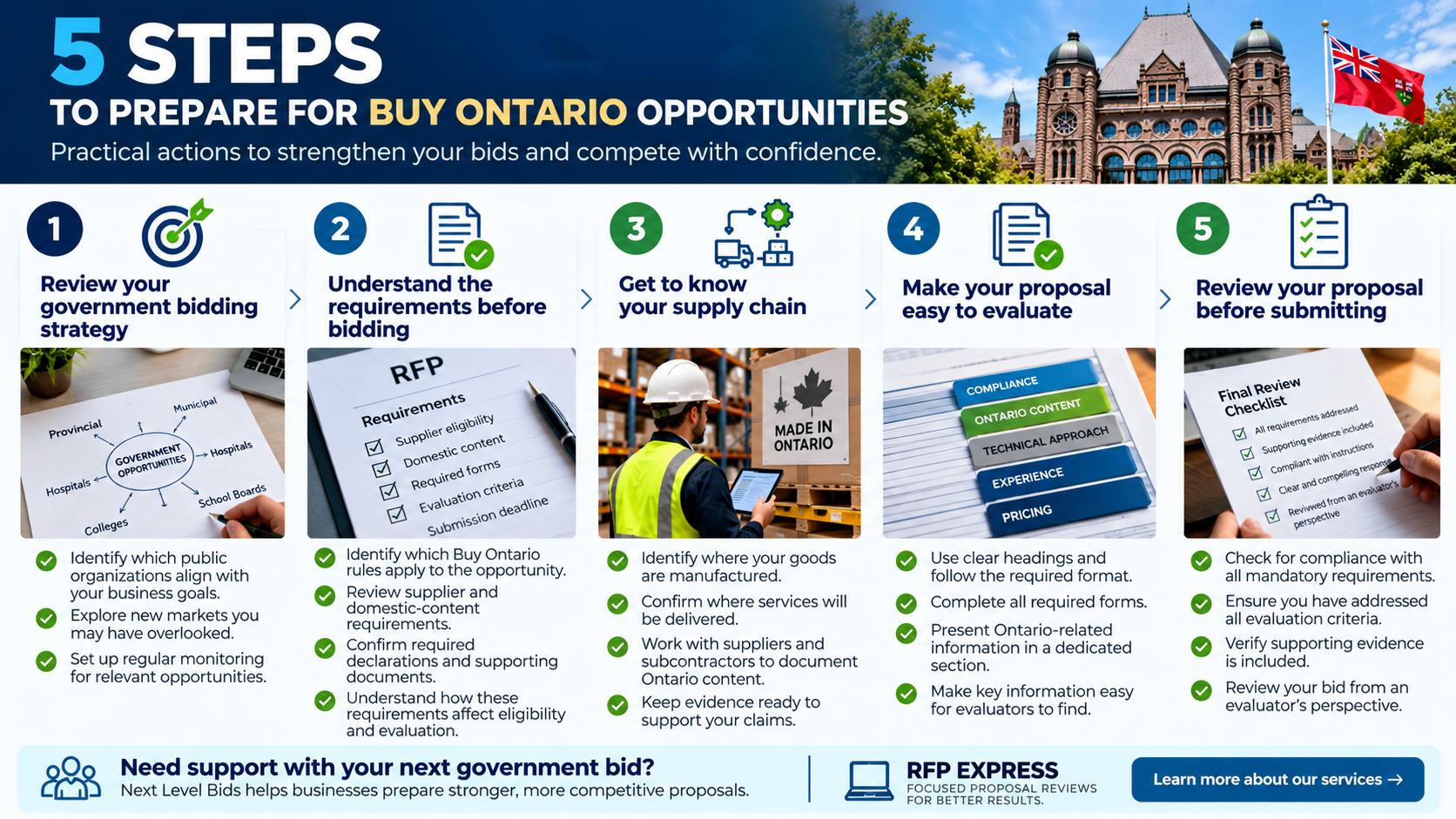
Review your government bidding strategy
If government contracts are part of your growth strategy, revisit the types of opportunities you pursue.
Are you monitoring provincial opportunities? Municipal tenders? Hospitals, colleges or school boards?
Consider whether the changing procurement environment creates opportunities in markets you previously overlooked.
Understand the requirements before bidding
Do not treat every Buy Ontario reference as having the same meaning.
Before preparing a proposal, identify:
- Which public organization is purchasing.
- Which procurement rules and definitions apply.
- Whether the opportunity includes specific supplier or domestic-content requirements.
- What declarations and supporting documents are required.
- How those requirements affect eligibility, evaluation or contract performance.
The solicitation documents should guide your response.
Get to know your supply chain
Can you identify where your major products are manufactured?
Do you know which suppliers can substantiate domestic-origin claims?
If you rely on subcontractors, can they confirm where the services will be delivered?
Gather this information before a submission deadline approaches.
Make your proposal easy to evaluate
A strong bid makes important information easy to find.
If a tender asks for evidence of domestic content, avoid burying the answer inside a lengthy company description.
Use clear headings, complete the required forms, and connect supporting information directly to the requirement.
A good proposal should not make evaluators search for the answer.
Review your proposal before submitting
Procurement preferences do not eliminate the need for a compliant and competitive proposal.
You still need to satisfy mandatory requirements, demonstrate relevant experience, address rated criteria and present a clear offer.
Before submission, review your bid from an evaluator’s perspective.
Ask yourself: Have we answered what the buyer actually asked, or what we assumed they wanted?
That distinction matters.
5. Common mistakes that could cost you an opportunity
As businesses adjust to Buy Ontario requirements, several avoidable mistakes deserve attention.
- Assuming local status guarantees preference.
A company’s Ontario presence does not mean it automatically qualifies under every procurement rule. - Making claims without supporting evidence.
If your bid states that a product is Ontario-made, you should be able to substantiate that statement using the applicable definition. - Overlooking mandatory submission requirements.
An otherwise attractive bid may face compliance problems when declarations, forms or mandatory information are missing. - Treating procurement preferences as a substitute for competitiveness.
Buy Ontario does not mean buyers can ignore the other requirements of a competitive procurement. Your proposal still needs to demonstrate capability, compliance and value. - Reusing the same response for every public buyer.
Provincial, broader-public-sector and municipal requirements can differ. Tailor your bid to the actual solicitation instead of assuming last month’s response will work again.
6. Is your business ready for the opportunity?
Buy Ontario represents an important development in Ontario’s public procurement environment.
For some suppliers, it may create additional opportunities to compete.
For others, it may require a closer look at sourcing, documentation and how they demonstrate compliance.
Either way, the businesses that understand the requirements and prepare credible, well-structured proposals will be better positioned to respond.
That is where good bid preparation becomes important.
Make your next government bid stronger with Next Level Bids
At Next Level Bids, we help businesses navigate complex government RFPs, understand evaluation requirements and strengthen their proposals before submission.
Whether you need help managing a bid from start to finish or want an experienced review of a proposal already underway, we offer support tailored to your needs.
Our RFP Express service provides focused, evaluator-informed proposal reviews that help identify compliance gaps, weak responses and opportunities to improve clarity before submission.
Preparing for your next government opportunity?
Explore our bid support and proposal review services or contact Next Level Bids to discuss how we can help.
