Submitting a government RFP response can involve weeks of work. Yet when the evaluation begins, your proposal is judged against something much more specific than how impressive the overall document looks.
Evaluators score what you actually wrote against the requirements and evaluation criteria published in the RFP.
Understanding that distinction can significantly improve how you prepare your proposal.
Evaluators Score Against the RFP, Not Your Company
One of the most common mistakes bidders make is assuming that a strong company will automatically receive a strong score.
It does not work that way.
An evaluator may know that your company has significant experience, a strong reputation, and capable staff. But if your response does not clearly demonstrate those strengths against the specific evaluation criteria, the evaluator may have little basis to award the available points.
Your response needs to make the evaluator’s job easy.
For every rated requirement, ask:
- What exactly is being evaluated?
- What evidence have we provided?
- Where in our response can the evaluator find that evidence?
- Have we answered every part of the question?
- Have we demonstrated the value of our approach rather than simply describing it?
Step 1: Mandatory Requirements Usually Come First
Before detailed scoring begins, many RFPs include mandatory requirements.
These can include:
- required forms
- signatures
- certifications
- minimum experience
- insurance requirements
- submission deadlines
- required pricing documents
- technical requirements
- declarations and attestations
A proposal can be well written and competitively priced and still be disqualified if it fails a mandatory requirement.
This is why a compliance review should happen before you focus on improving writing style.
The first question should be:
Are we compliant?
Only after that should the focus move to:
How do we maximize our score?
Step 2: Rated Criteria Determine Where the Points Come From
Most government RFPs tell bidders how their proposals will be evaluated.
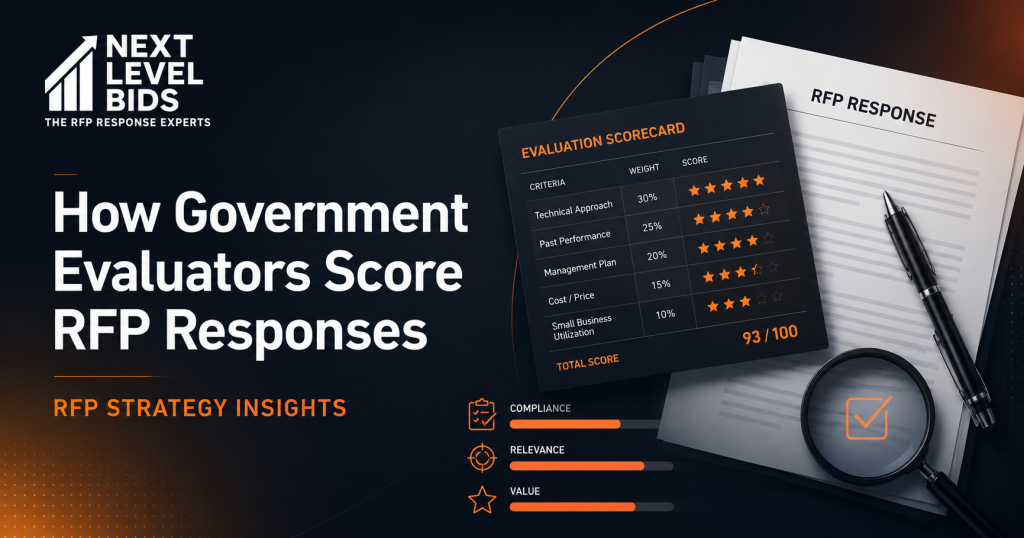
For example, an RFP might allocate:
- 20 points for experience
- 25 points for methodology
- 15 points for project team
- 10 points for implementation
- 30 points for pricing
That scoring structure should influence how much effort you put into each part of your response.
If methodology is worth 25 points and a minor corporate background section is worth 5 points, your team should not spend the same amount of time on both.
The evaluation weighting tells you what the buyer considers important.
Use it as a roadmap for your proposal effort.
Step 3: Evaluators Look for Evidence
Weak RFP responses often make claims without supporting them.
Consider these two statements.
Statement 1:
Our company has extensive experience delivering similar projects.
Statement 2:
Over the past five years, our team has delivered 18 comparable projects for public sector organizations, including six projects of similar size and complexity to this requirement.
The second statement gives the evaluator something measurable.
Whenever possible, support your claims with:
- numbers
- examples
- outcomes
- client experience
- project results
- timelines
- performance measures
- qualifications
- lessons learned
Do not expect the evaluator to assume that your company can deliver.
Show them.
Step 4: Answer Every Part of the Question
Government RFP questions often contain several requirements within one paragraph.
For example:
Describe your proposed implementation approach, including project governance, key milestones, risk management, stakeholder engagement, and transition activities.
That is not one question. It contains at least five things the evaluator may be looking for.
A bidder that provides an excellent explanation of project governance but barely addresses transition activities may lose points.
A useful technique is to break each question into its individual components before writing the response.
You can then verify that every component has been addressed.
Step 5: Evaluators Apply the Published Scoring Method
Many RFPs provide a scoring scale.
A simplified example might look like this:
- 0: No response or unacceptable
- 1: Major deficiencies
- 2: Partially meets requirements
- 3: Meets requirements
- 4: Exceeds requirements
- 5: Significantly exceeds requirements
This creates an important distinction.
Simply meeting the requirement may not earn the highest score.
If you want to score above average, your response needs to demonstrate why your approach provides additional value, reduces risk, improves outcomes, or offers a stronger solution.
The question you should ask is not simply:
Did we answer the question?
Ask:
What would justify an evaluator giving this response a 4 or 5 instead of a 3?
Step 6: Different Evaluators May Read Your Response Differently
Evaluation committees typically include people with different backgrounds and priorities.
One evaluator may focus heavily on technical requirements. Another may care more about implementation risk. Another may focus on operational practicality.
This is why clarity matters.
Your response should not require the evaluator to interpret what you meant.
Use:
- clear headings
- direct answers
- structured tables where appropriate
- specific examples
- measurable commitments
- consistent terminology
Avoid long paragraphs that bury important information.
The easier your response is to evaluate, the easier it is for evaluators to identify the evidence supporting a strong score.
Step 7: Price Is Only One Part of the Evaluation
Many bidders focus heavily on being the lowest-priced supplier.
That can be a mistake.
Government RFPs frequently evaluate a combination of technical quality and price.
Depending on the RFP, the lowest-priced proposal may receive the highest pricing score, but that does not automatically make it the highest-ranked proposal overall.
A bidder with a stronger technical score may still win with a higher price.
Your pricing strategy should therefore consider:
- the percentage of points allocated to price
- the pricing formula
- competitor positioning
- your technical strength
- the value demonstrated in your proposal
- the risk of pricing too aggressively
Always review the actual pricing methodology in the RFP before deciding how to position your price.
The Value of a Mock Evaluation
Before submitting an important proposal, try evaluating it as though you were the buyer.
Take the published evaluation criteria and score your own response.
For each criterion, identify:
- the maximum available points
- the evidence contained in your response
- weaknesses or missing information
- the score you believe an evaluator might reasonably award
- changes that could improve that score
This is very different from proofreading.
Proofreading asks:
Is this written well?
A mock evaluation asks:
Would this score well?
That distinction can reveal weaknesses that are easy to miss when your team has spent weeks working on the proposal.
Before You Submit
A strong government proposal should pass three tests:
Compliance: Have we met every mandatory requirement?
Evaluation: Have we clearly addressed every rated criterion?
Evidence: Have we given evaluators enough information to justify awarding a strong score?
If you can answer yes to all three, you are in a much stronger position when the evaluation begins.
Need a Second Set of Eyes?
Next Level Bids reviews proposals from the perspective of a procurement evaluator. Our RFP Express reviews include compliance checks, mock scoring, identification of weak responses, pricing review, and practical recommendations you can apply before submission.
Explore our RFP Express packages to have your proposal reviewed before the deadline.
